How to Sing High Notes Without Straining Your Voice
Learning how to sing high notes is one of the most common goals among singers. Whether you are just starting out or you have been singing for years, the upper part of your range can feel like a wall — a place where the voice suddenly becomes unreliable, tight, or simply stops responding the way you want.
The good news is that this wall is usually not permanent. In most cases, it is the result of habits that can be changed: too much pressure, the wrong kind of tension, or simply not knowing what to pay attention to while you practice.
At VocalabSinging, Salvador and Chloé work with singers of all levels who are trying to expand their range or make their high notes more consistent. What they observe most often is not a voice that is physically incapable — it is a voice that is working too hard in the wrong direction.
Most singers, when they struggle with a high note, do the same thing: they try harder.
They push more air. They tighten the throat. They lift the chin. They brace the body. And the note either comes out strained, or it does not come out at all.
The problem is that a high note does not need more muscular force. It needs a specific adjustment — a change in how the vocal folds vibrate, how the air moves, and how the mouth and throat shape the sound. When a singer pushes instead of adjusting, the body resists rather than cooperates.
The Voice Foundation describes this clearly: efficient voice production depends on the vocal folds closing correctly, moving with flexibility, and adjusting their tension in response to pitch — not on pressure from the outside.
This is the shift that makes the biggest difference for most singers: from trying to force the note to learning what the note actually needs.
What High Notes Actually Require
A high note is not a different kind of singing. It is the same coordination as the rest of your voice, applied with more precision.
Three things are involved:
Vocal fold adjustment. As pitch rises, the vocal folds need to modify how they vibrate. This happens through the muscles of the larynx, not through the throat closing or the jaw tightening. The more relaxed the surrounding muscles are, the more freely this adjustment can happen.
Controlled airflow. Many singers believe that higher notes need more air. In practice, the opposite is often true. More air can create more pressure and more resistance. What high notes need is air that is well-managed — consistent and smooth, not pushed.
Resonance in the right place. The vocal tract — the throat, mouth, and pharynx — shapes and amplifies the sound produced by the vocal folds. Small changes in how you position the tongue, shape the vowel, or open the space inside the mouth can make a high note feel dramatically easier. This is why two singers can attempt the same note and one finds it effortless while the other struggles, even if their voices are similar.
Why the Body Gets in the Way
Most of the tension that interferes with high notes is not intentional. It builds up gradually as the singer tries to compensate for a coordination that has not yet developed.
Over time, patterns like these become automatic:
Lifting the chin as the pitch rises
Tightening the jaw on high notes
Pulling the tongue backward
Bracing the shoulders or abdomen
Holding the breath slightly before an exposed note
Changing the vowel drastically to avoid the difficulty
None of these habits help. But they persist because they feel like effort, and effort feels productive — even when it is not.
The other factor is psychological. Many singers develop a specific relationship with a difficult note: they begin to expect the problem before it arrives. That anticipation alone creates tension in the body that was not there before. By the time the note comes, the voice is already working against resistance it created itself.
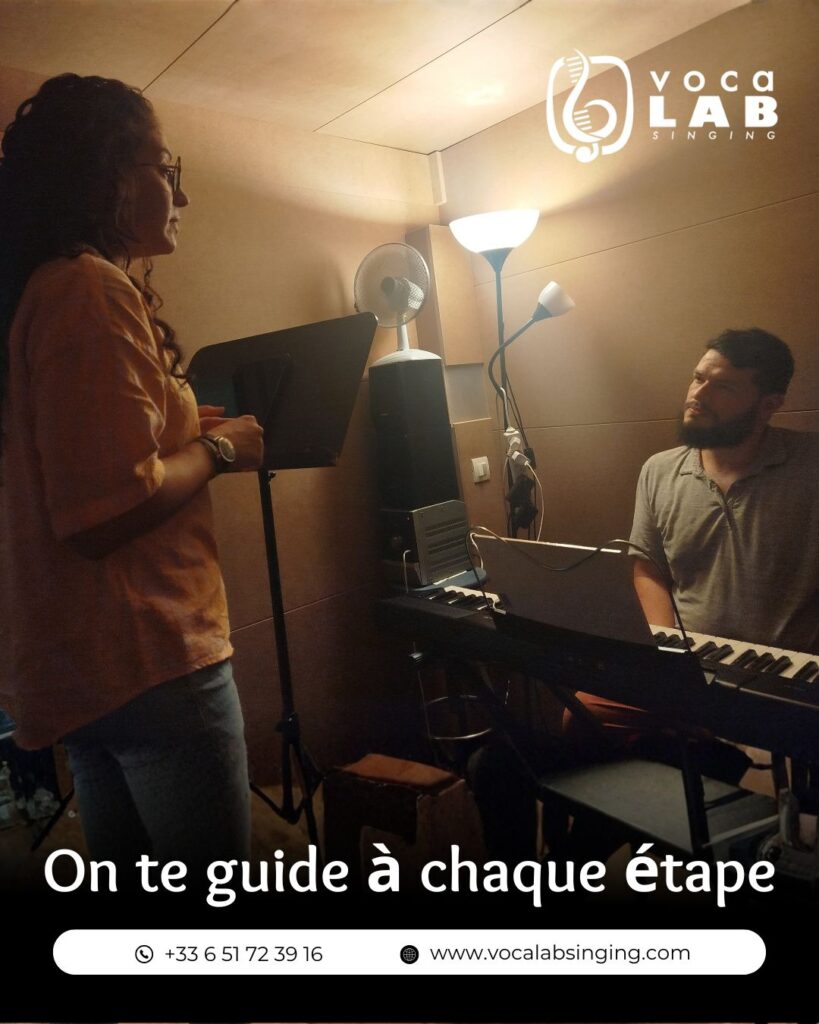
At VocalabSinging, Salvador and Chloé consistently ask students: “How did that feel?” — not just “How did it sound?” This is intentional. The sensations the singer notices during practice are often more informative than the sound, because they reveal where the body is interfering and where it is cooperating.
Vocal Lab How to Sing High Notes
How to Practice High Notes More Effectively
The most common mistake in practicing high notes is also the simplest to change: repeatedly singing the same difficult note and expecting a different result.
Repetition builds habit. If the habit driving the difficult note is inefficient, repeating it simply makes it more automatic.
Here is a more productive approach.
Prepare Before You Challenge Anything
Do not begin practice by immediately testing the top of your range. Your voice needs time to organize itself before it is ready for demanding work.
A few minutes of easy humming, lip trills, or gentle slides through comfortable pitches does two things: it warms up the physical mechanism gradually, and it gives you a reference point for what coordination feels like when the voice is working without pressure.
Work the Phrase, Not Just the Note
A high note does not exist in isolation. It sits inside a musical phrase, and it depends on what happened in the previous notes.
If you are struggling with a specific moment in a song, start two or three notes before it. Notice what changes in your body as the pitch rises. Often the real problem is not the high note itself — it is the preparation: the breath held slightly too soon, the jaw beginning to tighten one note early, the body bracing in anticipation.
Practicing the approach changes the result at the arrival.
Use Exercises as Tools, Not Routines
Exercises are only useful if they help you find a better coordination. A lip trill that reduces the feeling of effort on a high note is telling you something useful. A scale that produces the same tension as the song is not solving the problem — it is just postponing it.
Some starting points that many singers find helpful:
Lip trills through ascending patterns: They reduce the sensation of effort and reveal when the voice is coordinating without muscular interference.
Humming on a closed vowel: Often more accessible than open-vowel singing at higher pitches, and useful for building resonance awareness.
Slow slides from low to high: They help the voice transition gradually rather than jumping to a specific pitch with all the associated anticipation.
Singing on a modified vowel: Sometimes changing the vowel shape slightly — making a bright [a] slightly rounder, or opening a tight [e] — frees the resonance at a higher pitch and makes the note feel completely different.
The right exercise depends on the specific voice. What matters is using exercises to explore different coordinations, not to drill the same pattern indefinitely.
Pay Attention to What You Feel
As you practice, notice what is happening in your body — not to control every muscle, but to catch the moments when something changes.
A sudden increase in jaw tension. A feeling of the throat narrowing. A change in where the sound seems to be coming from. These sensations are information. They tell you where the coordination is still developing and where you might be compensating.
When tension appears unexpectedly, the most useful response is not to push through it. It is to return to a lower, more comfortable pitch, re-establish the feeling of ease, and approach the difficulty again from a less pressured position.
Vowels and High Notes
One of the most practical discoveries a singer can make is that vowels behave differently at different pitches.
The shape of the vowel — how the tongue is positioned, how open the mouth is, how the space inside the throat is organized — directly affects how efficiently the sound resonates. At higher pitches, a vowel that worked perfectly in the middle range might start creating unnecessary tension.
This does not mean that high notes require distorted or unclear vowels. It means that singers who allow themselves some flexibility in how they shape vowels tend to find high notes significantly more accessible than singers who hold every vowel exactly the same regardless of pitch.
Exploring small adjustments — a slightly rounder shape on a bright vowel, a bit more space in the back of the mouth on a tight one — can completely change the experience of a difficult note. This is one of the areas where a teacher’s ear is particularly useful, because the adjustment that helps is often very small and hard to discover alone.
What the Voice Is Not Telling You
Something worth understanding about difficult high notes: the feeling of effort is not always accurate.
Many singers who are using inefficient coordination describe their technique as feeling like they are “really working.” When the coordination improves, they often report that the note suddenly feels “too easy” — almost like they are not doing enough. That feeling is not a sign that something is wrong. It is the absence of the tension they were mistaking for effort.
This is one reason singers benefit from external guidance. It is difficult to distinguish between effort that is helping and effort that is interfering without a point of reference.
Salvador and Chloé at VocalabSinging work with each student’s specific situation. Two singers struggling with the same note will often need completely different adjustments — one may be using too much air, another may be holding the jaw, another may simply be approaching the note with more expectation than the voice can handle. A generic solution cannot address these differences; an individualized one can.
What VocalabSinging Students Say
“During the past two years my singing technique has developed, healthy and correctly. His classes are even more than just technique — he helped me with diction, characterization of the role, and even life and career advice. He has my gratitude for all his teaching.” — Fernando Castillo
“Chloé and Salvador are true professionals. We see that they love to pass on their knowledge and the pleasure of singing. With patience, imagination, and good humor, they find the right technique to help everyone progress at their own level and pace. A lesson with them is always a huge pleasure.” — Sylvie Mettraux
“Chloe is really great. The lessons are dynamic and very informative. If you want to progress and learn to master your voice, this is the right place. She really listens to what it feels like to sing and adapts the exercises. It’s very stimulating.” — Audrey Lagoutte
“Chloe’s classes are absolutely top notch. She is very attentive to her students, corrects and motivates by transmitting various tools to improve. Highly recommended for anyone who wants to pamper themselves. Singing frees me and puts me in a good mood.” — Alexia Musso
VocaLab How to Sing High1
Frequently Asked Questions About Singing High Notes
Do I need a natural gift to sing high notes? Most difficulties with high notes come from habits and coordination patterns, not from a fixed physical limitation. Singers who believe certain notes are simply out of reach often discover a different reality once the specific pattern blocking those notes is identified and worked through.
How long does it take to develop a higher range? There is no single answer. Some singers notice a change quickly because they were using obvious excess tension that is relatively easy to release. Others take months to develop new coordination reliably. A more useful measure than how high you can sing once is how consistently and comfortably you can sing a note repeatedly, in different contexts.
Is it normal to feel discomfort when I try high notes? Muscle activation during singing is normal. Pain, persistent hoarseness, or a feeling of increasing strain are signs worth taking seriously. If these are present, rest and professional evaluation are more appropriate responses than more practice.
Can children develop high notes too? Yes, with approaches that respect their vocal development. At VocalabSinging, lessons for children use shorter formats and focus on natural, healthy coordination rather than demanding technical extremes.
What is the difference between a singing teacher and a vocal coach for this kind of work? Both can be helpful. What matters most is whether the person guiding you can listen to your specific voice, identify what is creating the problem, and help you develop a different coordination — rather than applying the same generic solutions to every student.
High Notes and Vocal Health
One important principle that should guide all work on high notes: pushing through pain or persistent strain is never the right solution.
A high note that consistently requires discomfort, produces hoarseness, or leaves the voice feeling more tired than before is providing feedback worth listening to. The goal is a note that can be sung comfortably, repeatedly, and musically — not one that can be forced once in a good moment.
If the voice is hoarse or tired, resting it is more productive than practicing demanding material. If hoarseness or unusual effort persists, consulting a health professional with experience in voice is the appropriate step.
The VocalabSinging Approach
Salvador and Chloé founded VocalabSinging from their own experience as singers — including the experience of developing vocal problems through incorrect teaching and having to rebuild their technique from a more informed starting point. That history shapes the way they teach.
Their method works through three connected dimensions:
Understanding the body. Before asking students to modify what they are doing, Salvador and Chloé help them understand why the voice works the way it does. When a singer understands the mechanism, the exercises make more sense and the changes tend to last.
Paying attention to sensation. Technique is not only what the teacher hears. It is also what the student feels. The ongoing conversation about what singing feels like from the inside — where it is easy, where it is tight, where something changed — is central to how lessons develop.
Singing real music. Exercises are connected to repertoire, not separated from it. Technical adjustments are applied directly to the songs students want to sing. This is not a shortcut; it is how technique becomes part of a singer’s voice rather than something that only works in isolation.
Lessons are available in person at their studio in Sainte-Foy-lès-Lyon (Lyon area, France) and online for students anywhere in the world. A free first class is available for those who want to experience the method before committing.
Conclusion: Coordination Is the Answer
High notes become easier not when you push harder, but when you understand what they actually need — and stop doing what gets in the way.
The most productive path is gradual, attentive, and connected to real music. Prepare the voice before asking it to perform. Work the phrase, not just the note. Notice what the body is doing and distinguish between effort that helps and effort that interferes. And give the voice time to develop new coordination rather than demanding immediate results.
At VocalabSinging, that process happens one voice at a time — because every singer’s situation is different, and the solution that works is always the one that fits the individual.



2 réponses