Most singing methods are built around one idea: what the teacher knows. The student listens, imitates, and tries to reproduce the result. When it works, it works. When it doesn’t, the student often concludes that the problem is their own voice.
Salvador and Chloé started VocalabSinging from the opposite direction.
Both went through periods where incorrect understandings of vocal technique created real difficulties for their own voices. That experience did not discourage them — it gave them a more honest and more useful framework for teaching. They became coaches not because they had always sung perfectly, but because they understood, from the inside, what it feels like when technique fails and how to rebuild it correctly.
This is the foundation of the VocalabSinging method: two professional singers, two different musical histories, and one shared philosophy — that every voice is individual, and every singer deserves a learning process that reflects that.
What Vocal Technique Actually Is
Vocal technique is not a set of rules that singers must memorize and execute.
It is a coordination. A dynamic relationship between breathing, vocal fold activity, resonance, articulation, posture, and musical intention.
The Voice Foundation describes voice production as an interconnected system: the respiratory system provides airflow, the vocal folds transform that airflow into sound, and the vocal tract — throat, mouth, nasal cavities — shapes and amplifies that sound into what the listener hears.
This means that changing one part of the system affects the others.
A singer who tightens the jaw does not only create jaw tension. They affect resonance, articulation, and the coordination of the rest of the mechanism. A singer who pushes excessive air does not only exhaust the breath faster. They create pressure that the vocal folds must work against.
Good vocal technique is not about controlling everything. It is about developing enough understanding of the system to stop interfering with it.
That understanding is precisely what Salvador and Chloé aim to give each student.

Two Backgrounds, One Philosophy
Salvador: From Guatemala to Lyon
Salvador’s path into singing began with lyrical training, but his musical world has never stayed within one style. Rock, pop, jazz, variété — he has worked across genres that require different technical and expressive approaches.
This breadth is not accidental. It reflects a conviction that vocal training should serve the student’s musical life, not define it. A student who wants to sing musical theatre should not be forced to develop an opera voice. A student who loves French chanson should not have to navigate a method designed for classical repertoire.
Salvador’s ability to move between styles gives him a practical understanding of how the same vocal mechanism needs to adapt — and how training can develop flexibility rather than fixing the voice into one shape.
His own vocal difficulties — and his subsequent work to understand them — gave him something that no amount of easy success could have provided: the ability to recognize, from the inside, what a student is actually experiencing when something is not working.
Chloé: Lyrical Training and the Art of Helping Others Find Their Voice
Chloé began singing as a child and pursued higher music education with the specific objective of becoming an opera singer. That formal training gave her a rigorous foundation in breath, resonance, support, and vocal endurance.
But alongside that classical training, she maintained a deep interest in other styles — variété, pop, traditional singing — and a growing understanding of what she describes as helping people find their own voice.
That phrase is worth pausing on, because it points to something important about how Chloé approaches teaching.
The goal is not to make students sound like her.
The goal is to give them the tools to understand their own instrument — and to develop it according to their own musical identity.
Why Having Two Teachers Matters
A lesson at VocalabSinging is not the same as having two teachers give conflicting opinions.
Salvador and Chloé work from a shared philosophy: Comprendre • Ressentir • S’entraîner • Développer sa voix — Understand, Feel, Practice, Develop Your Voice.
What their different backgrounds add is something more subtle: complementary ways of listening, explaining, and demonstrating.
One may explain a technical concept through anatomy. The other may make the same concept accessible through a specific sensation or a musical example. One may notice a tension pattern in the jaw. The other may approach that same pattern through a different exercise.
For the student, the result is a richer, more layered learning experience — not two methods competing, but two perspectives working together toward the same goal.
Why Vocal Technique Is Different for Every Singer
There is a persistent idea in vocal pedagogy that there is one correct technique and every singer needs to find it.
The reality is more nuanced.
Two singers can produce healthy, efficient, expressive voices using noticeably different physical strategies. This happens because singers differ in anatomy, vocal fold characteristics, vocal tract dimensions, breathing habits, muscular coordination, and musical background — among many other factors.
A teaching approach that ignores these differences will often produce one of two outcomes: either the student happens to match the template the teacher is working from, and progress seems natural; or they don’t, and both teacher and student conclude that the student has a problem.
VocalabSinging’s philosophy grew directly from the founders’ experience of this second situation — and from their subsequent determination to build something better.
The relevant question is never “What exercise should every singer do?”
It is: “What does this particular singer need to understand and experience right now?”
That shift in perspective changes everything about how a lesson is structured.
What Good Vocal Training Can Develop
When vocal technique is taught in a way that genuinely fits the individual singer, the results go well beyond the technical.
Coordination and efficiency. Singers learn to produce more with less effort — not by pushing harder, but by interfering less with the mechanisms that already know how to work.
Range and flexibility. Rather than forcing notes at the extremes of the range, singers develop the coordination that allows the voice to move more freely through its full spectrum.
Resonance. Small adjustments in how the vocal tract is shaped — tongue position, jaw openness, space in the pharynx — can dramatically change how a voice projects and what colors it can produce.
Pitch and consistency. Understanding the relationship between airflow and vocal fold activity gives singers more reliable control over pitch, especially under pressure.
Expression. Technical security and emotional expression are not opposites. When singers stop worrying about whether the note will come, they are free to think about what they want to say with it.
Confidence. This is perhaps the most underrated outcome of good vocal training. Singers who understand their instrument stop being afraid of it.
The Role of Physical Awareness in Vocal Technique
One of the distinctive features of VocalabSinging’s approach is the consistent attention to what happens inside the singer during phonation — not only what comes out.
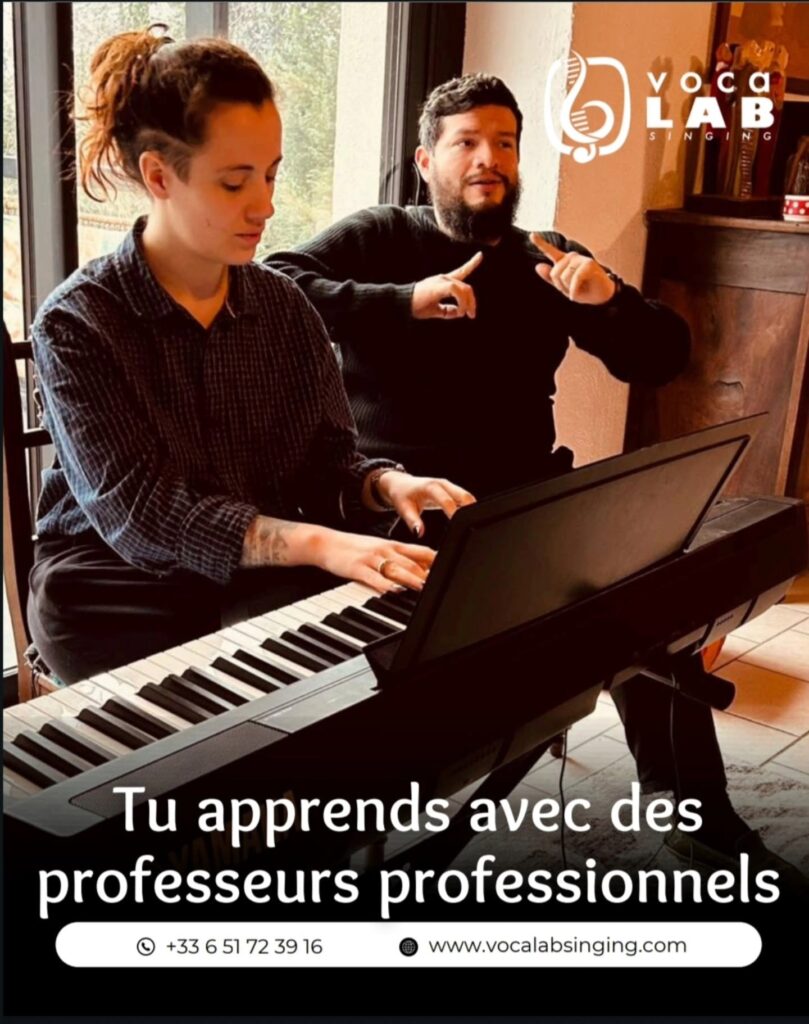
During lessons, Salvador and Chloé regularly ask students: “How did that feel?”
This is not a secondary question. It is often the most informative one.
The singer’s physical experience during a phrase — where there is ease, where there is resistance, where something suddenly changes — provides information that the teacher cannot fully access from the outside alone. A teacher can hear that a note is tense. The student can feel where the tension is, and whether it appeared before or after the note began.
This dialogue between what is heard and what is felt is how technique actually becomes internalized. Without it, students can produce a correct sound in a lesson and have no idea how to reproduce it the next day.
With it, technique becomes something the singer carries independently.
What Singers Say About Training with Salvador and Chloé
The most direct way to understand what learning at VocalabSinging is like is through the people who have done it.
“During the past two years my singing technique has developed, healthy and correctly. His classes are even more than just technique — he helped me with diction, characterization of the role, and even life and career advice. He has my gratitude for all his teaching.” — Fernando Castillo
“Chloé and Salvador are true professionals. We see that they love to pass on their knowledge and the pleasure of singing. With patience, imagination, and good humor, they find the right technique to help everyone progress at their own level and pace. A lesson with them is always a huge pleasure.” — Sylvie Mettraux
“Chloe is really great. The lessons are dynamic and very informative. If you want to progress and learn to master your voice, this is the right place. She really listens to what it feels like to sing and adapts the exercises. It’s very stimulating.” — Audrey Lagoutte
“Chloe’s classes are absolutely top notch. She is very attentive to her students, corrects and motivates by transmitting various tools to improve. Highly recommended for anyone who wants to pamper themselves. Singing frees me and puts me in a good mood.” — Alexia Musso
Several things stand out across these accounts: individual attention, adaptability, the quality of the transmission, and — repeatedly — the atmosphere of the lessons. Good mood. Pleasure. Stimulation.
These are not incidental details. They reflect a teaching environment where the student feels safe enough to try, fail, adjust, and grow.
Vocal Technique at Different Levels
The same foundational philosophy applies across experience levels, but what it looks like in practice changes considerably.
Beginners benefit most from establishing efficient habits early. Breathing coordination, posture, pitch awareness, and basic resonance — building these correctly from the start avoids years of having to undo patterns that felt right but weren’t.
Intermediate singers often arrive at a point where they know they are capable of more but cannot identify what is preventing progress. This is frequently a coordination problem: range, register transitions, resonance, or confidence under pressure. Identifying the specific pattern is more than half the solution.
Advanced and professional singers may need more precise adjustments — preparation for a demanding programme, work on endurance, interpretation, or fine technical calibration. Their training builds on a foundation that already exists; the goal is precision rather than construction.
At VocalabSinging, lessons are available for adults and children, beginners and professionals, in person in the Lyon area and online for students anywhere in the world. A free first class is available for those who want to experience the method before committing.
Frequently Asked Questions About Vocal Technique and Singing Lessons
Can anyone learn vocal technique, or is it only for trained singers? Vocal technique is for anyone who wants to sing — whether that is professionally, as a hobby, or simply for the pleasure of it. The principles of healthy, coordinated voice production apply regardless of experience level. What changes is how they are introduced and developed.
What is the difference between vocal technique and singing style? Technique refers to the coordination of the physical and acoustic systems that produce the voice: breathing, vocal fold activity, resonance, articulation. Style refers to how that technical foundation is applied musically — the choices a singer makes about tone, phrasing, interpretation, and expression. Good technique makes style possible; it does not replace it.
Is it possible to learn vocal technique online? Yes. The fundamentals of vocal coaching — listening, observing, identifying patterns, adjusting exercises — transfer effectively to an online format. VocalabSinging offers online lessons at the same structure as in-person sessions, available to students worldwide.
How long does it take to notice improvement in vocal technique? The timeline varies significantly depending on the singer’s starting point, the specific issue being addressed, and the consistency of practice. Some changes — particularly those involving releasing obvious tension — can become noticeable within a few sessions. More structural coordination changes take longer. A more useful measure than a timeline is whether singing is becoming progressively more comfortable, consistent, and free.
What is the difference between working with one teacher versus two? A single excellent teacher is invaluable. Two teachers working from a shared philosophy add something specific: different ways of listening, explaining, and connecting with different learners. Some students respond immediately to an anatomical explanation; others need to feel a sensation first; others understand through music. Salvador and Chloé’s complementary backgrounds mean a student is more likely to find the explanation that actually connects.
Do singing lessons help with vocal health as well as technique? Healthy technique and vocal health are closely related. Many vocal difficulties — persistent hoarseness, fatigue, tension — are symptoms of coordination problems that good technique addresses. If a singer is experiencing persistent vocal symptoms, however, consulting a healthcare professional is the appropriate first step alongside any technical work.
How Vocal Technique Connects to Emotional Expression
A technically proficient voice that communicates nothing is not fully developed.
Singing is a form of communication. The physical coordination exists in service of the musical and human message — and that message requires the singer to be present, connected, and willing to be heard.
This is why emotional awareness is one of the three pillars of VocalabSinging’s methodology, alongside anatomical understanding and active singing practice.
Emotional states influence physical states. A singer who is nervous tends to hold their breath. A singer who is afraid of a high note tends to tighten before it arrives. A singer who is judging themselves internally tends to reduce the natural freedom of their voice.
Addressing technique without addressing these patterns leaves a significant part of the work undone.
Salvador and Chloé’s own histories — their periods of vocal difficulty and recovery — give them a particular sensitivity to this dimension of singing. They recognize what it feels like to doubt the voice, and they know that rebuilding technical confidence requires more than exercises alone.
For more on this topic: What Does It Mean to Sing with Emotion?
Conclusion: One Philosophy, Two Voices, Your Own
Vocal technique at VocalabSinging is not about copying a sound.
It is about understanding a system — yours — well enough to use it freely.
Salvador and Chloé bring different musical journeys to their teaching. A lyrical background extended into rock, pop, jazz, and variété. An opera training that never lost interest in other styles. Two careers that passed through difficulty and came out the other side with something more valuable than uninterrupted success: a genuine understanding of what singers need when technique is not working.
What they share is the conviction that the voice is personal, that every student deserves individual attention, and that good teaching creates independence rather than dependence.
The philosophy is simple enough to summarize in four words:
Understand. Feel. Practice. Develop your voice.
When technique becomes something you understand and feel — not merely something you are told to do — it stops being an obstacle and becomes part of how you sing.
Related Articles at VocalabSinging
- How to Sing High Notes Without Straining Your Voice
- How Personalized Singing Lessons Help You Discover Your True Voice with Salvador & Chloé
- Singing Anatomy: Understand, Feel, Practice, and Develop Your Voice
- What Does It Mean to Sing with Emotion?
External Reference
VocaLab Singing
Website: VocaLab Singing
Phone: +33 6 51 72 39 16
Email: info@vocalabsinging.com
Location: Sainte-Foy-lès-Lyon, France, with online lessons also available.
Social Media
Facebook: VocaLab Singing on Facebook
Instagram: @vocalab.singing on Instagram
YouTube: VocaLab Singing on YouTube
Leave a Review: Leave your review on Google
You Can See, How Personalized Singing Lessons Help You Discover Your True Voice with Salvador & Chloé
Tagged Apprendre à chanterbien-être par le chantchant en lignecours de chant débutantcours de chant Parisexpression artistiqueinterprétation émotionnellemaîtriser sa voixpotentiel vocalVocalab
You can See, How to Sing High Notes Without Straining Your Voice